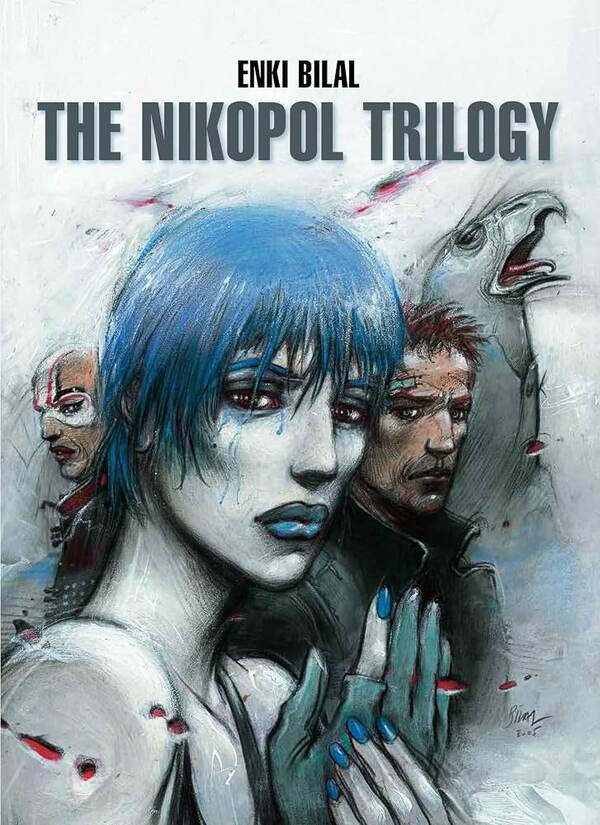
The Nikopol Trilogy
Enki Bilal
An exile returns to Earth and finds politics, memory, and ancient gods entangled in a damaged future.
Overview
Enki Bilal wrote and drew the three albums now known as The Nikopol Trilogy: The Carnival of Immortals (1980), The Woman Trap (1986), and Cold Equator (1992). Alcide Nikopol's return to Earth brings him into a violent, fractured political world where the Egyptian god Horus becomes part of his fate.
The albums move among different characters and locations rather than holding to one straightforward adventure. Their connections accumulate through displacement, power, and recurring figures, giving the trilogy the feeling of a future whose history has already gone wrong.
Why It Matters
The trilogy lets Bilal combine speculative politics with myth without treating either as an ornamental layer. A god can intrude on a technologically advanced society, yet the human institutions remain corrupt and familiar. The collision gives the work its uneasy humor and its sense of instability.
Bilal's long span between installments also matters. The three albums are related works made over more than a decade, not a single book first published in 1980. Their later collection under one title can obscure that progression.
The Science Fiction
Nikopol's return after a long absence makes the future strange through his eyes. Political violence and advanced systems have become ordinary to those living in them, while Horus's appearance disrupts any neat line between technological and supernatural power.
The trilogy's dystopia is less a single invention than a climate of damaged public life. Its speculative elements expose how institutions turn bodies and identities into instruments, and how difficult it is to remain outside their struggles.
Art & Visual Identity
Bilal's painted pages carry a worn, cold atmosphere. Faces and architecture can seem equally marked by conflict, so the future feels aged rather than new. His restrained color and dense surfaces slow the eye at moments when the plot is unstable.
That visual weight suits a trilogy in which memory and history keep intruding. Characters occupy spaces that look politically used, not freshly designed for spectacle. The art gives even mythic events a physical, urban setting.
Read This If You Like
- Dystopian European comics
- Science fiction mixed with mythology
- Political stories told through visual atmosphere
- Long-form work by a single writer-artist