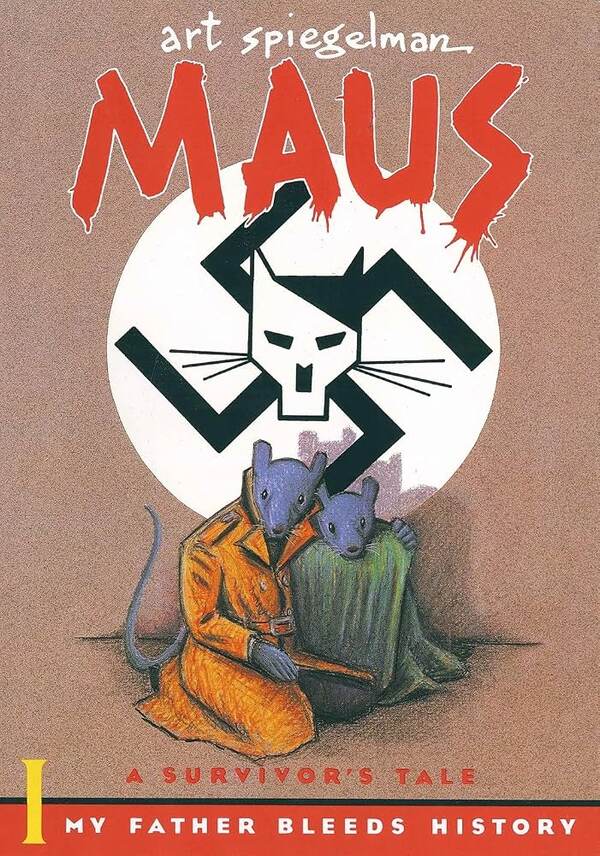
Maus
Art Spiegelman
An artist listens to his father’s Holocaust testimony and discovers how hard survival is to inherit.
Overview
Art Spiegelman reconstructs the wartime experience of his father, Vladek, a Polish Jew who survived Nazi persecution. The account moves between that history and the later conversations in which Vladek tells it.
Those interviews are not a neutral frame. The father and son argue, misunderstand each other and carry losses that the telling itself cannot resolve. Serialized in RAW from 1980, the work eventually appeared in two book volumes.
Why It Matters
Maus received a special Pulitzer citation in 1992. Its public recognition helped make clear that comics could sustain historically serious, formally complex nonfiction.
Its lasting force also comes from refusing an easy story of recovery. The present-day relationship shows that testimony carries the effects of history into ordinary family life.
Genre & Themes
The book is memoir, oral history and a study of representation. It asks what a son can know from a survivor’s account, and what cannot be transferred by any narrative.
The animal imagery makes categories of persecution visible while also exposing how blunt and artificial those categories are.
Art & Visual Identity
Spiegelman uses stark black-and-white drawing and compact panels. The visual economy keeps attention on testimony, pauses and contradictions.
Changing settings and time periods remain clear, even when memory and present conversation interrupt one another.
Read This If You Like
- Graphic memoir
- Holocaust testimony
- Family history
- Comics about memory