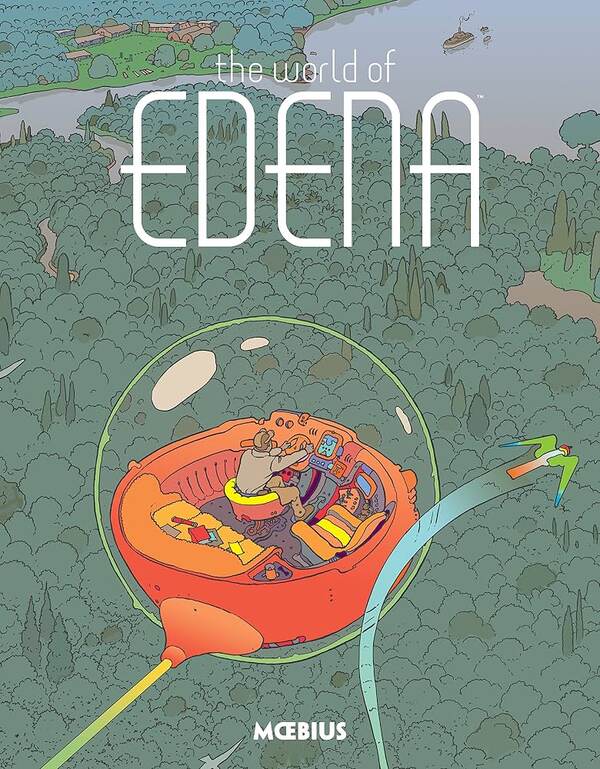
The World of Edena
Mœbius (Jean Giraud)
A search for a missing station turns into a journey through a paradise that changes its visitors.
Overview
Written and drawn by Mœbius, The World of Edena follows interstellar investigators Stel and Atan as they look for a lost space station and crew. Their discovery of the planet Edena changes the direction of the search. The cycle moves from expedition to a more inward, dreamlike encounter with identity, desire, and the natural world.
Dark Horse's English collection gathers five chapters: Upon a Star, Gardens of Edena, The Goddess, Stel, and Sra. That collection appeared in 2016, well after the work's beginnings in the 1980s. This profile concerns the cycle as a whole, not the publication date of the English hardcover.
Why It Matters
The cycle shows Mœbius using science-fiction travel as a route toward psychological and philosophical questions. A missing-station premise promises investigation, but Edena asks the visitors to examine what they thought they needed. The change in scale—from space search to altered self-understanding—is the work's defining turn.
Its structure also rewards reading as a sequence rather than a single encounter with an exotic planet. The five chapters allow the setting and the travelers to change together. The continuity gives the work a patient rhythm unusual for an adventure built on interstellar movement.
The Science Fiction
Stel and Atan begin with a recognizable spacefaring task: locate people who have vanished. Edena upends that practical mission by behaving less like a destination to survey than an environment that acts on its visitors. The speculative question becomes what an unfamiliar world might reveal about habits brought from home.
The planet's promise of paradise is deliberately unstable. Wonder and vulnerability arrive together, so exploration is also a test of self-definition. The science-fiction setting gives Mœbius a way to move between cosmic distance and intimate transformation.
Art & Visual Identity
Mœbius's open line and spacious compositions make Edena feel different from a crowded mechanical future. Natural forms and wide expanses leave room for hesitation and discovery. The eye can linger on a landscape before being pulled back to the travelers inside it.
That visual breathing room supports the cycle's change of emphasis. The art is less concerned with displaying equipment than with making distance, bodily presence, and atmosphere felt. As the story becomes more inward, the environment remains a visible partner in the characters' transformation.
Read This If You Like
- Philosophical planetary science fiction
- Mœbius's more contemplative work
- Journeys that change the travelers
- Surreal landscapes and open-page drawing