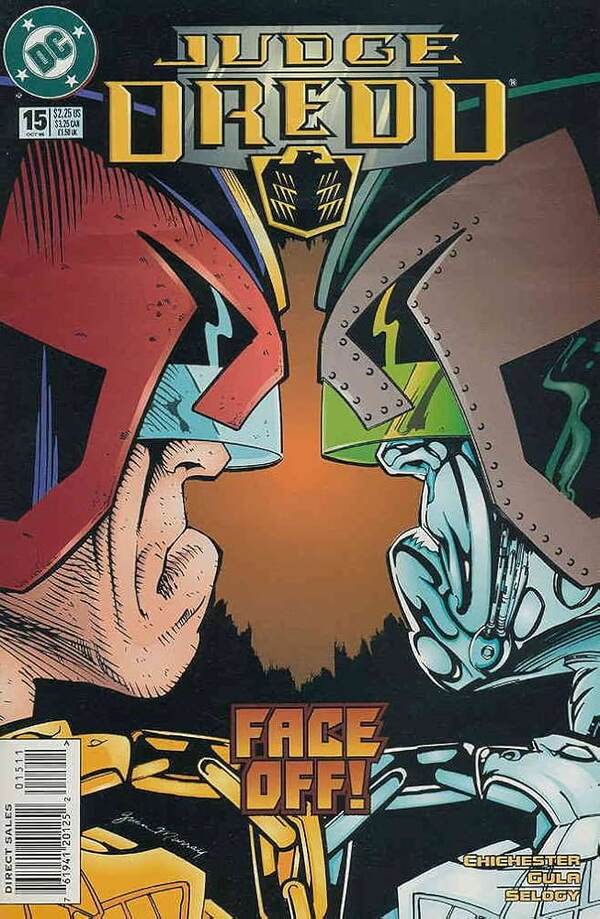
Judge Dredd
Written by John Wagner, Pat Mills, Alan Grant, et al.. Art by Carlos Ezquerra, Brian Bolland, et al..
In Mega-City One, the law is a person with a helmet, a gun, and almost no room for doubt.
Overview
Created by John Wagner and Carlos Ezquerra, Judge Dredd first appeared in 2000 AD Prog 2 in 1977. He patrols Mega-City One, a huge future city on the American East Coast. Its Judges can arrest, sentence, and execute, putting extraordinary power into the hands of officers who claim to keep an unmanageable population under control.
The strip follows Dredd through cases that range from brief street-level absurdities to long crises for the city. He is disciplined and often personally incorruptible, yet he serves a coercive system. That tension lets a story use him as a forceful action lead while asking readers to notice the cost of the order he enforces.
Why It Matters
2000 AD calls Dredd its longest-running character. Decades of strips have allowed the city, its laws, and its citizens to change around him while preserving a recognizable central figure. The feature's endurance comes partly from that flexibility: it can work as police procedural, dystopian adventure, or dark comedy.
Its satire is sharpest when a ridiculous offense receives an entirely serious response. Dredd's certainty can be funny, frightening, or both, depending on who has been caught in the system. The comic makes authoritarian power dramatic without requiring the reader to mistake its protagonist's commitment for justice.
The Science Fiction
Mega-City One is an exaggerated urban future where mass population and institutional power grow together. The Judges' combined roles remove the distance between accusation and punishment. That is the strip's central speculative device: a city that presents summary force as an efficient solution to social disorder.
The setting also makes room for larger catastrophes, strange technologies, and threats from beyond the city. Yet even an outlandish crisis returns to the same civic question: how much control will this society grant its enforcers, and what happens to people who have almost none?
Art & Visual Identity
Ezquerra's creation gave Dredd an immediately imposing silhouette: helmet, eagle insignia, armor, and a face largely hidden from view. That concealment matters. The figure can seem less like an individual than a walking institution, even when a story tests his judgment.
The visual identity has been expanded by many artists, including Mick McMahon and Brian Bolland. Their different approaches can make the city grimy, monumental, or grotesquely comic. The common thread is excess: oversized buildings, crowds, and uniforms make Mega-City One look like a place built to overwhelm the people inside it.
Read This If You Like
- Dystopian satire with dark humor
- Future cities built around extreme policing
- Long-running British anthology comics
- Action stories that question their own hero