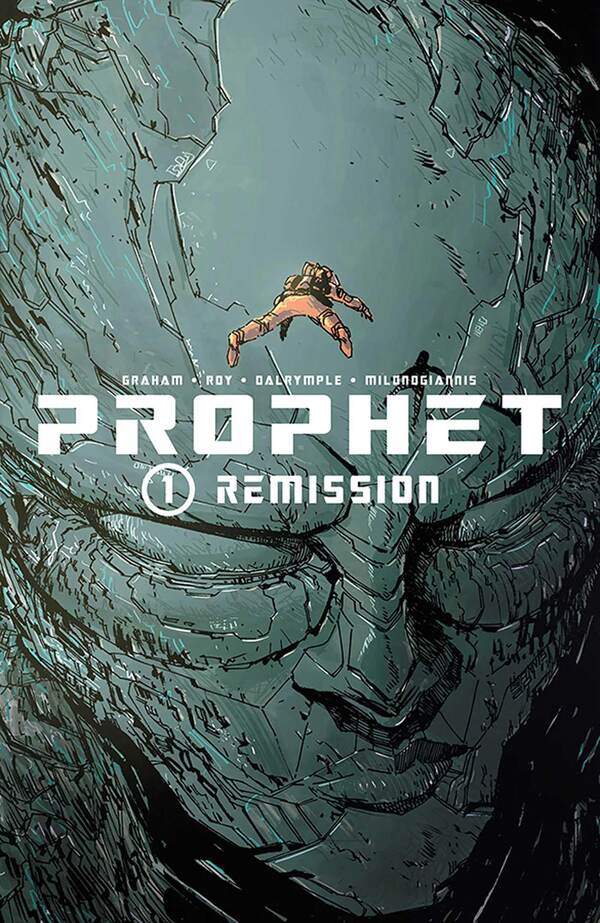
Prophet (2012 Revival)
Written by Brandon Graham, Simon Roy, et al.. Art by Simon Roy, Giannis Milonogiannis, et al..
A soldier wakes on a future Earth so altered that survival becomes a form of exploration.
Overview
Image Comics revived Rob Liefeld's Prophet in 2012 with Brandon Graham leading the writing and Simon Roy drawing the opening issues. John Prophet crosses a future Earth full of unfamiliar species, predators, and cultures while trying to reach and awaken the G.O.D. Satellite.
The revival treats its inherited protagonist as a way into a much stranger setting. Later artists and collaborators expanded the world, but its opening direction is clear: the journey is about learning how to exist in environments that no longer center humans.
Why It Matters
The relaunch transformed a 1990s Image property into a far-future survival comic. Image described it as a reimagining by independent creators rather than a simple return to the original formula. That distance gave Graham and Roy room to make unfamiliar ecology the main source of suspense.
The result rewards attention to the small mechanics of living: food, shelter, local creatures, and improvised tools. Its epic scope grows from those details instead of replacing them.
The Science Fiction
Future Earth is an ecology of competing forms of life. Prophet's mission gives him direction, but each encounter demands adaptation. The speculative question is less whether humanity can conquer the landscape than whether one human can read it accurately enough to keep moving.
The G.O.D. Satellite hints at a larger technological and political history. The comic lets that history emerge gradually through the world itself, making the reader share Prophet's uncertainty.
Art & Visual Identity
Roy's organic forms give the opening arc an uncomfortable tactility. Creatures feel built for their environments, and Prophet looks vulnerable among them. The drawing invites the reader to examine surfaces and anatomy for clues about how this world works.
As the revival widened, different artists brought new textures to other parts of the setting. That variation suits a world too large for one visual vocabulary, while the opening pages establish its basic rule: nothing should be assumed familiar.
Read This If You Like
- Far-future survival stories
- Alien ecologies and biopunk design
- Comics that reinvent older characters
- Exploration built from environmental detail