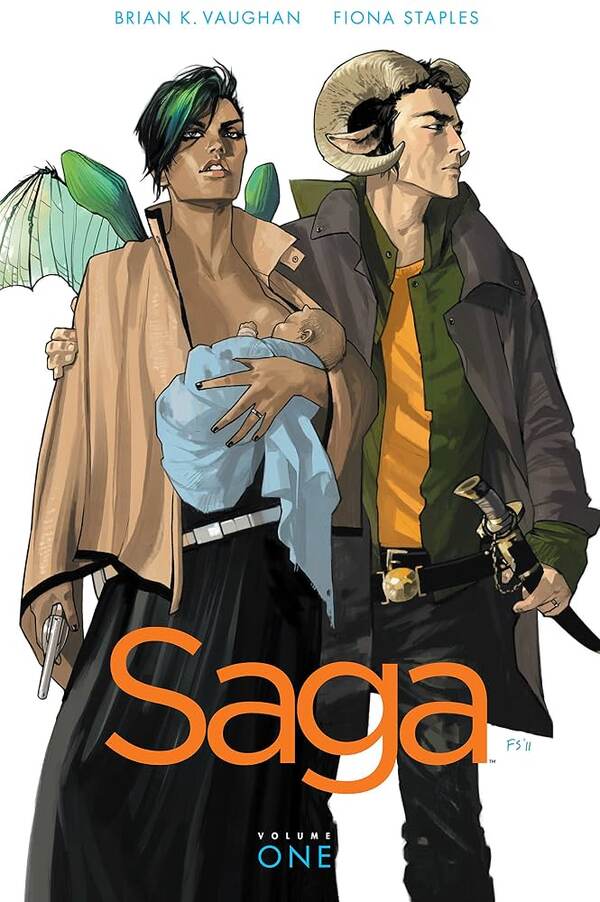
Saga
Written by Brian K. Vaughan. Art by Fiona Staples.
A family tries to grow while two worlds insist on continuing their war.
Overview
Created by writer Brian K. Vaughan and artist Fiona Staples, Saga began at Image Comics in March 2012. Alana and Marko come from opposing sides of a galactic conflict. Their decision to raise their daughter Hazel together makes them targets, turning a vast space war into the immediate problem of keeping a child alive.
The story moves through strange planets, shifting alliances, and an ever wider cast, but Hazel's family remains its center. Her occasional narration gives the adventure a long view: childhood continues even when adults treat survival as an emergency. The series mixes space opera with fantasy, domestic comedy, and violence intended for adult readers.
Why It Matters
Saga won both Best New Series and Best Continuing Series at the 2013 Eisner Awards. The recognition followed a launch that joined Vaughan's appetite for a long serial with Staples's ability to make an invented universe legible from its first pages. Image announced it as a creator-owned collaboration rather than a licensed franchise.
Its particular achievement is scale. An interplanetary war can remain abstract; a tired parent deciding whom to trust cannot. By placing an improvised family inside the conflict, the comic makes large political divisions visible in small daily decisions. Its worlds can be extravagant without letting spectacle displace the people moving through them.
The Science Fiction
The central speculative premise is an apparently endless war between peoples whose identities are treated as incompatible. Alana and Marko's relationship exposes how much of that incompatibility is enforced by institutions, propaganda, and fear. Their child becomes a living challenge to the categories that organize the fighting.
Space travel expands the story's geography, while fantasy elements prevent the universe from feeling like a system of hardware alone. The mix lets Vaughan and Staples move from battlefield to family life without changing the central question: what can children inherit besides the conflicts of their parents?
Art & Visual Identity
Staples draws a large cast with immediately distinct silhouettes and expressions. Soldiers, robots, and creatures belong to a coherent world even when their designs draw on wildly different visual ideas. That clarity lets the comic move quickly through unfamiliar locations without losing the emotional line of a scene.
Her most effective contrast is between the spectacular and the ordinary. A strange body or immense setting can share a page with a simple gesture of care or exhaustion. The design work supplies wonder, while faces and posture keep the narrative anchored in the family's shifting bonds.
Read This If You Like
- Space opera seen through family life
- Science fantasy with eccentric creatures
- Stories about war, displacement, and parenthood
- Long-form creator-owned comics