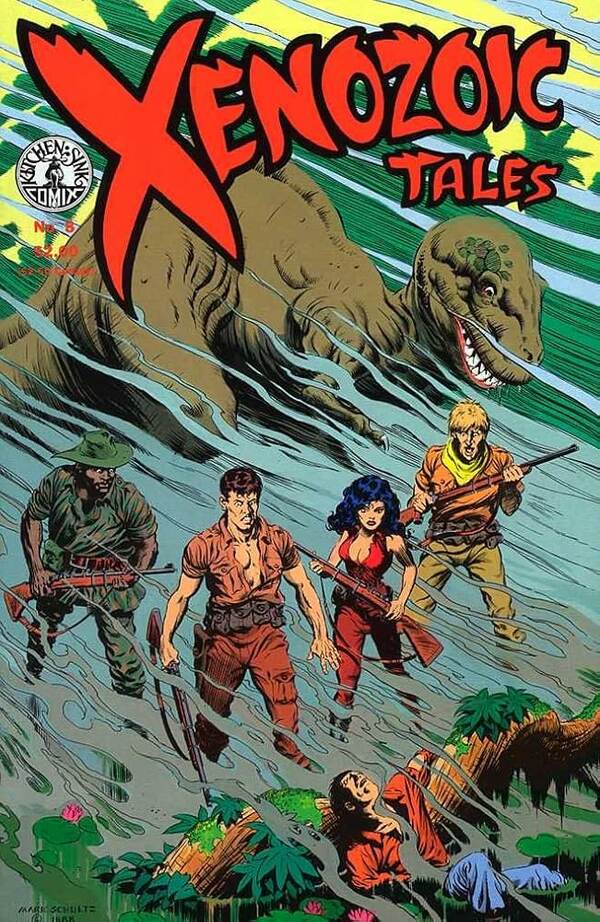
Xenozoic Tales (Cadillacs and Dinosaurs)
Mark Schultz
After ecological collapse, humans return to an Earth where prehistoric life has reclaimed the surface.
Overview
Mark Schultz's Xenozoic Tales began as a story in 1986, followed by a Kitchen Sink Press series in 1987. After centuries underground, people emerge into a transformed world of dinosaurs, altered ecosystems, and scavenged technology.
Adventurers including Jack Tenrec and Hannah Dundee navigate the tension between exploration and stewardship. Survival depends on understanding the revived environment, not merely mastering it.
Why It Matters
The comic joins pulp action to ecological caution. Its spectacular animals are also reminders that human history did not end when people withdrew from the surface.
Schultz's work makes a ruined world feel abundant. That choice changes the usual post-apocalyptic question from how to rebuild the old order to whether it should be rebuilt at all.
The Science Fiction
The transformed Earth is an experiment in consequences across deep time. Past ecological decisions have made a future in which humans are no longer the uncontested dominant species.
Old machines remain useful, but they can also repeat the habits that caused the catastrophe. The title's juxtaposition of dinosaurs and cars captures that tension in one image.
Art & Visual Identity
Schultz's controlled ink-and-brush drawing gives animals, vegetation, and machines a strong physical presence. The black-and-white pages connect natural-history observation to adventure-comics energy.
The world looks dangerous because it is alive and complex, not empty. That visual abundance carries the story's ecological argument.
Read This If You Like
- Ecological post-apocalypse
- Dinosaurs and lost technology
- Detailed black-and-white art
- Pulp adventure with environmental stakes