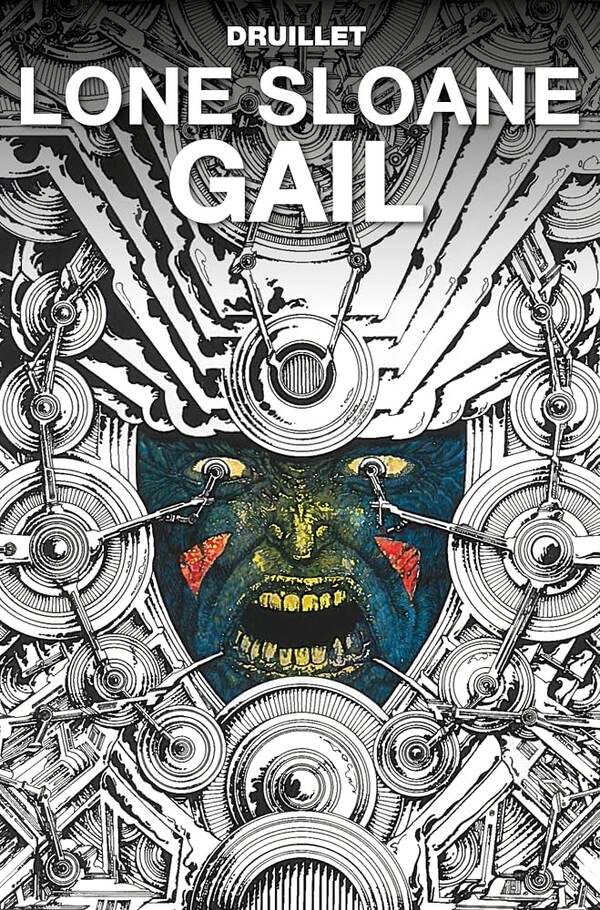
Lone Sloane
Philippe Druillet
Philippe Druillet sends a traveler through worlds too vast and ornate to stay inside ordinary panels.
Overview
Lone Sloane first appeared in Philippe Druillet's Le Mystère des Abîmes in 1966. Druillet later returned to the character in Pilote, expanding his cosmic voyages through stories that made strange powers and monumental environments central to the experience.
Sloane is a point of movement through the work rather than a quiet guide to a stable universe. Each new encounter allows Druillet to change the scale and visual rhythm, making the journey feel perilous even when the plot is closer to myth than technical science fiction.
Why It Matters
The Galerie Huberty & Breyne describes Druillet's Pilote pages as formally audacious and unlike the regular layouts around them. That is the series' clearest historical distinction: it pushes the page itself to convey the scale of cosmic events.
The 1966 debut and the later Pilote run should be kept separate. The first introduced the character; the subsequent work established the expansive visual vocabulary for which Lone Sloane is often remembered.
The Science Fiction
Space here is a realm of immense civilizations and powers rather than a navigable chart of planets. The speculative appeal lies in scale and estrangement. Encounters can make Sloane appear small before forces that look ancient, technological, and supernatural at once.
That blend places the work near science fantasy. Its inventions are designed to overwhelm, and their effect on the reader is as important as a precise explanation of how they function.
Art & Visual Identity
Druillet breaks and enlarges panel structures to make the page feel architectural. Borders, ornament, and crowded detail can turn a sequence into a spectacle that must be explored rather than simply scanned.
The compositions give cosmic distance a physical shape. When a figure is dwarfed by machinery or a vast structure, scale becomes the storytelling: the reader understands the imbalance before the dialogue explains it.
Read This If You Like
- Psychedelic space opera
- Experimental page design
- Science fantasy at monumental scale
- 1970s French comics innovation