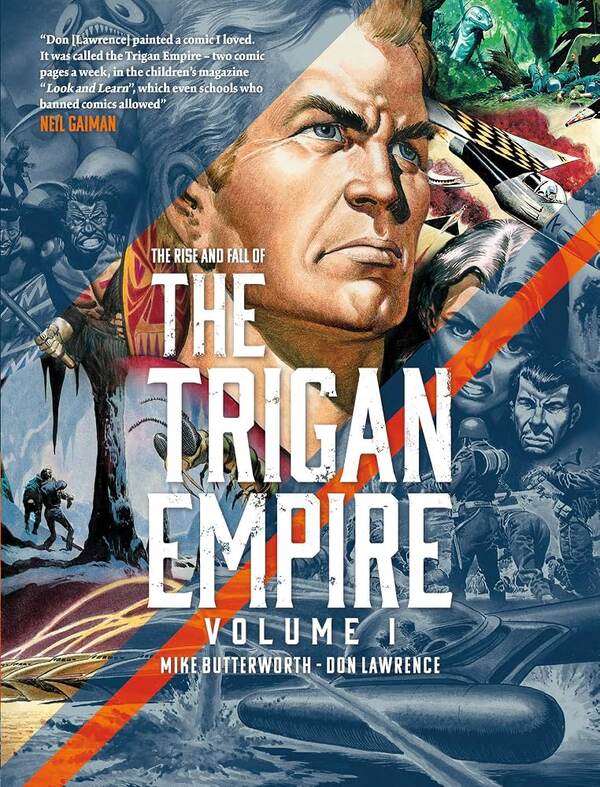
The Trigan Empire
Written by Mike Butterworth. Art by Don Lawrence, et al..
A space-age civilization rises and falls with the grandeur of an ancient epic.
Overview
Mike Butterworth and Don Lawrence created The Rise and Fall of the Trigan Empire for the British magazine Ranger in 1965. The series moved through the politics, wars, and discoveries of an invented civilization whose futuristic machines coexist with classical-looking cities and imperial conflicts.
Its tales use a shared world rather than one continuous quest. Rulers, rivals, and soldiers give the history many points of entry, while the rise-and-fall frame asks readers to see each victory as part of a longer political cycle.
Why It Matters
The feature was designed as a leading attraction for Ranger. Lawrence drew it for more than a decade, establishing a visual scale that distinguished it from many weekly adventure strips. The original team gave an illustrated historical sweep to a science-fiction setting.
The work's retro-futurism is more than a mixture of costumes and vehicles. It lets imperial ambition look both ancient and futuristic, suggesting that technical sophistication does not end familiar struggles over territory and authority.
The Science Fiction
The invented civilization supplies room for technologies and conflicts untethered from real history. Yet its institutions resemble empires readers recognize. That blend lets the stories ask whether a society can change its tools without changing its politics.
The setting's long chronology makes change itself a subject. New inventions and new rulers can alter the balance of power, but the series keeps returning to the fragility of any empire's claim to permanence.
Art & Visual Identity
Lawrence's painted pages give machines, architecture, and landscapes a rich physical presence. Crowded scenes can carry the weight of mass movement, while panoramic views make the civilization seem older and larger than any one episode.
His attention to surface and light supports the series' historical tone. Even speculative devices look embedded in a lived world, helping the comic hold together its unusual blend of classical spectacle and future adventure.
Read This If You Like
- Retro-futurist empires
- Painted British adventure comics
- Long fictional histories
- Science fiction with classical visual motifs